
Section 2
Knowledge Gathering
Solving a Problem Begins with Understanding Hunger and Food Insecurity
To make plans to solve a complex problem, you need to know the contours of the problem—and the more you know, the more precise your plans can be. To that end, spread your gathering of knowledge far and wide.
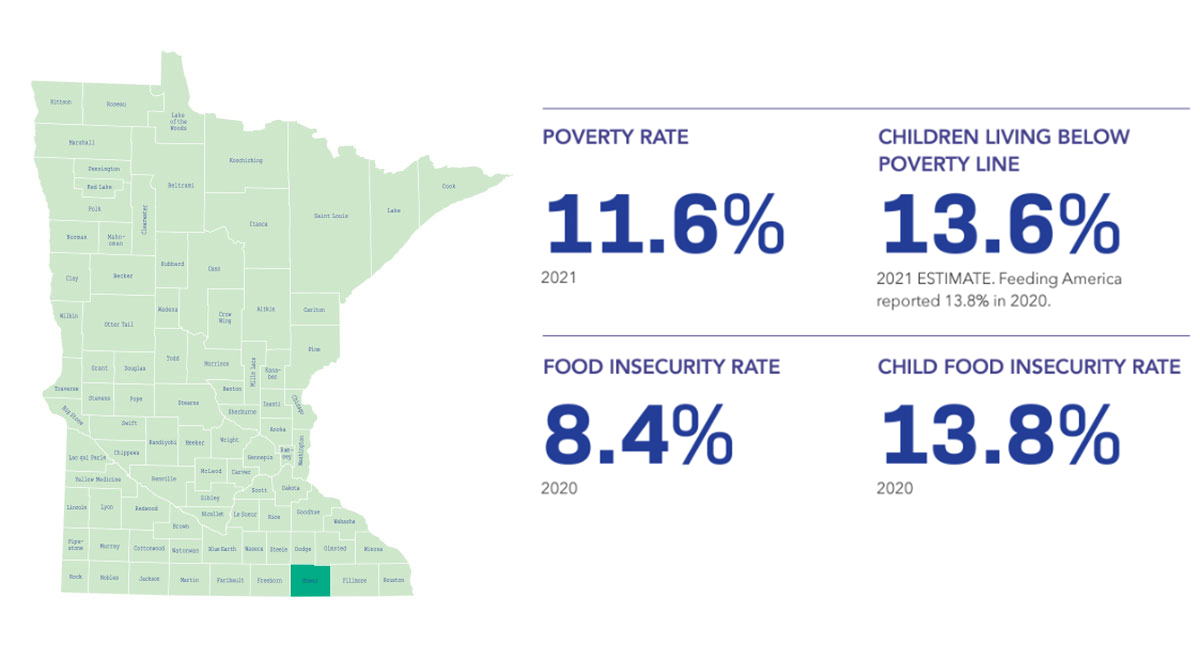
Because food insecurity has dozens of overlapping causes, we felt it was important to start with a deep dive into the causes and extent of food insecurity in Mower County. That work resulted in the Hunger and Food Insecurity Community Assessment Report released in April 2023. The 111-page report focused on understanding both the short-term and long-term needs of at-risk communities as well as identifying all the potential resources and stakeholders in the county.
We encourage you to explore our Community Hunger Assessment Report for ideas and insights that will help your efforts.
Writing our community assessment for Mower County, Minnesota, helped us learn and synthesize a lot of information in a short time and made it easy to share that knowledge base with others.
Highest Risk Populations
Starting out, it is helpful to be aware of populations at the highest risks for experiencing food insecurity. Here are some examples:
- Those experiencing a disability, whether physical or mental health issue
- Those experiencing unemployment
- Those who were recently incarcerated
- Black, non-Hispanic households
- Hispanic households
- Those living in certain zip codes
- Adults living alone, particularly seniors
- A surprising finding for us was that adults age 50–59 in Mower County were experiencing high rates of food insecurity
The Critical Importance of SNAP
The Supplemental Nutrition Assistance Program, commonly known as SNAP and formerly referred to as Food Stamps, is our nation’s broadest food safety net, designed for the most vulnerable people and families in our communities.
According to the USDA Food and Nutrition Service, in fiscal year 2023, four in five (seventy-nine percent) SNAP households included either a child, an elderly individual, or a non-elderly individual with a disability. It is hard to overestimate the importance of SNAP. Research from the USDA Economic Research Service (2025) shows that the program is highly effective at accomplishing its goal of reducing food insecurity.
After filling out an application (usually with their state or county), recipients get an Electronic Benefits Card (EBT) which works much like a credit or debit card at stores that accept them. Benefits are added to the card monthly, and debited as they are used for food purchases.
According to Dr. Craig Gundersen, a foremost authority and researcher on food insecurity at Baylor University, there are several reasons why SNAP is so effective at reducing food insecurity:
- The program reaches those most in need.
- It provides a substantial amount of food funding for those in need. A family of four could be eligible for up to nearly $1,000 per month.
- It is an entitlement program that remains constant during economic cycles.
- It can be used at virtually all retail food outlets.
- It provides dignity and autonomy to recipients.
Definitions and Acronyms
IYKYK: We learned there are a lot of acronyms, definitions and nuances that were helpful to master. Here are a few:
- “Hunger” vs Food Insecurity: Food insecurity is an official term from the United States Department of Agriculture (USDA) for when people don’t have enough to eat and don’t know where their next meal will come from. Hunger is the state of not having food to eat.
- Food Insecurity Rate: Percentage of households that were food insecure at some point during the year. Food security has traditionally been measured in the United States using the USDA’s Food Security Supplement to the Current Population Survey (CPS). The survey is conducted by the U.S. Census Bureau for the USDA’s Economic Research Service. It measures household food security in the United States, including the availability of adequate food and the ability of households to access it. This information is used by government agencies, nonprofits and researchers to understand and address issues of food insecurity in the country.
- Food Insecurity Scale: The USDA also measures the level of food security within a household on a four-level scale. Low and Very Low are considered “food insecure.” Learn more.
- High food security—Households had no problems, or anxiety about, consistently accessing adequate food.
- Marginal food security—Households had problems at times, or anxiety about, accessing adequate food, but the quality, variety and quantity of their food intake were not substantially reduced.
- Low food security—Households reduced the quality, variety and desirability of their diets, but the quantity of food intake and normal eating patterns were not substantially disrupted.
- Very low food security—At times during the year, eating patterns of one or more household members were disrupted and food intake reduced because the household lacked money and other resources for food.
- FRLP: Free or Reduced Lunch Program. The National School Lunch Program (NSLP) is a federal program providing nutritionally balanced food and low-cost or free lunches to children at schools and residential programs through the FRLP since 1946. The number of students eligible for FRLP is used in many states to determine whether the school receives universal free lunch. Learn more at National Center for Education Statistics.
- TFP: The Thrifty Food Plan is an estimate by the U.S. Department of Agriculture of how much it costs to provide a market basket of nutritious, low-cost meals for a household family of four. This calculation is factored into the Cost of Living Adjustments, which affect SNAP benefit rates.
- FPL: Federal Poverty Level: Each year, the U.S. Department of Health and Human Services issues a report with income levels for households below which they are considered to be living in poverty. For 2024, the levels were set at:
1 person: $15,060
2 people: $20,440
3 people: $25,820
4 people: $31,200
5 people: $36,580
6 people: $41,960
7 people: $47,340
8 people: $52,720
FPL is used to establish various benefit levels. For example, households with income up to double the FPL (200%) are generally eligible for SNAP benefits in most states.
- Social Determinants of Health: This term refers to the various economic and social conditions that affect health status. Read more below, or visit Health.gov.
Determinants of Food Insecurity
Economic Stability
- Poverty
- Unemployment
- Wages
- Sudden household economic crisis
- Homelessness
- High rent-to-income ratios
- Regional economic downturn
- Lack of education, training opportunities and other employment enablers
Social and Community Context
-
Discrimination and/or systemic racism
-
Immigration status
-
Recent incarceration
-
Language barriers
-
Cultural food restrictions
-
Rural isolation
-
Shame as a barrier for accessing resources
-
Lack of knowledge or understanding of resources
-
Community-wide disasters
Mental and Physical Health
-
Depression, anxiety, post-traumatic stress disorder or other serious mental health challenges
-
Physical disability
-
Chronic disease
-
Lack of access to healthcare
-
Alcohol or drug addictions